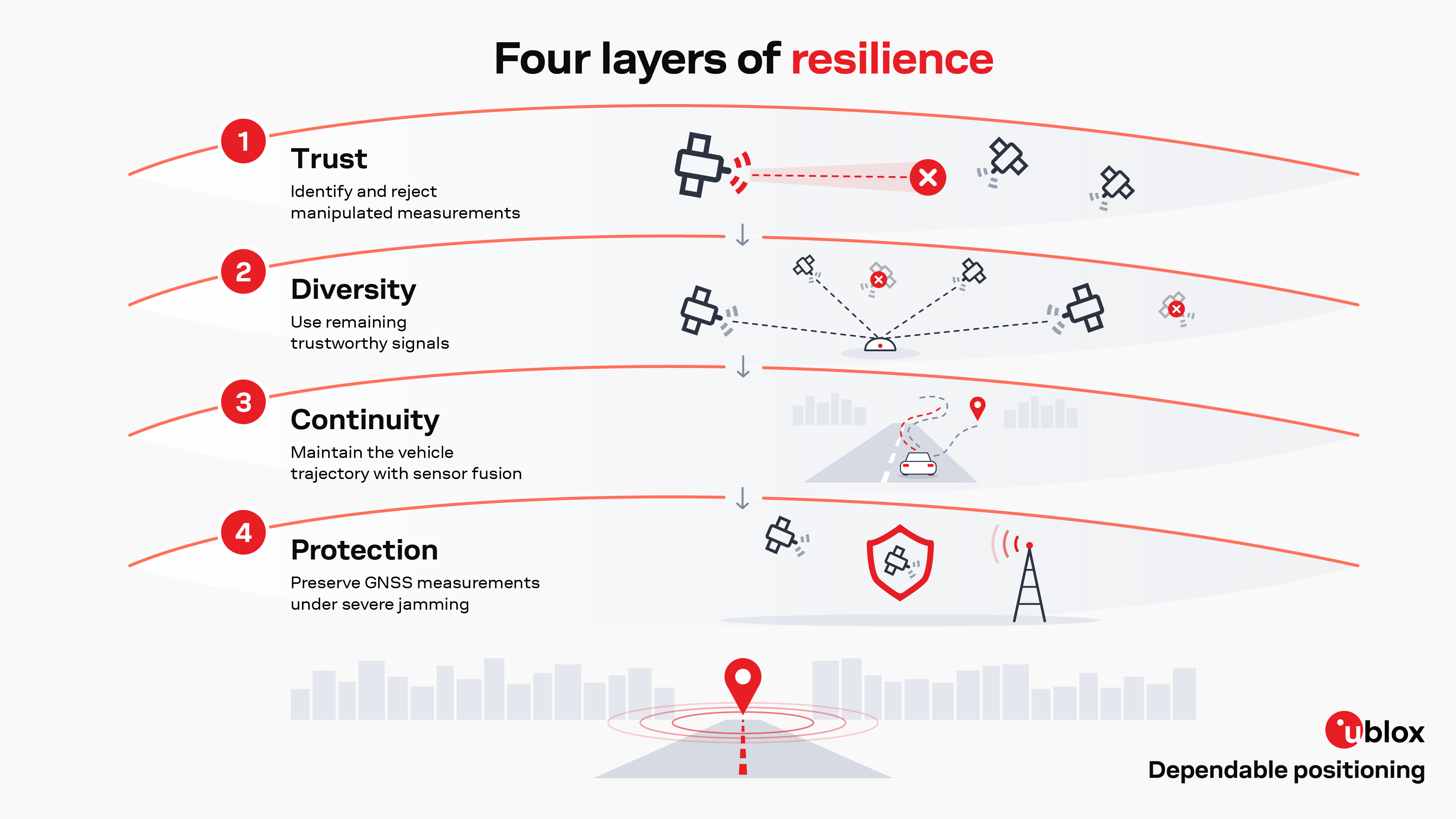
What does it take to maintain trustworthy positioning and timing when GNSS signals are manipulated, degraded, or disrupted?
GNSS interference is no longer only about whether a receiver can detect jamming or spoofing. The bigger challenge is what happens next: which measurements can still be trusted, how long can positioning or timing remain useful, and how can a system recover as the signal environment changes?
At Jammertest 2026 in Andøya, Norway, u-blox tested GNSS technologies under controlled, real-world jamming, spoofing, and meaconing scenarios.
Register now for this webinar on December 1, 2026
In this webinar, our experts will share key findings from the campaign and explore what they mean for resilient GNSS across high-precision positioning, standard-positioning, timing, and APNT applications.
We will look beyond simple interference detection and examine how different layers of resilience work together to protect positioning and timing performance.
What you’ll learn
- Real-world insights from Jammertest 2026: What the test results reveal about resilience across standard precision GNSS (SPG), high precision GNSS (HPG), dead reckoning (DR), precise timing, and assured positioning, navigation and timing (APNT) applications.
- The value of all-band and all-constellation GNSS: Why access to more satellite signals does not automatically guarantee greater resilience, and how identifying and rejecting inconsistent measurements helps maintain reliable positioning.
- Maintaining positioning continuity through sensor fusion: How combining GNSS with inertial and other sensor data helps maintain positioning when satellite signals become unreliable or temporarily unavailable.
- Protecting GNSS performance under interference: How advanced interference detection and mitigation techniques help preserve usable GNSS measurements during severe jamming.
- Choosing the right GNSS solution for your application: How to select between single-band, multi-band, and all-band u-blox products based on your accuracy, resilience, performance, and cost requirements.
- Understanding Galileo navigation message authentication: How Galileo Open Service Navigation Message Authentication (OSNMA) works and how it helps protect against certain types of spoofing attacks.
- Exploring the future of resilient positioning with LEO: How low Earth orbit (LEO) satellite technologies could complement conventional GNSS and what u-blox is exploring in this emerging field.
Register now for this webinar on December 1, 2026
From detection to continuity
A resilient GNSS system should do more than recognize that something is wrong.
Depending on the application and interference scenario, resilience can mean selecting trustworthy measurements, making use of signal diversity, transitioning to sensor fusion, protecting GNSS reception, or maintaining reliable timing while the RF environment is compromised.
The goal is not to maintain an output at any cost.
It is to maintain an output that can still be trusted.
Why Jammertest?
Jammertest is an annual open-air PNT and GNSS resilience testing campaign in Andøya, Norway.
Unlike laboratory testing, it exposes receivers and complete positioning systems to live GNSS signals and controlled over-the-air interference in a real environment.
2026 marked u-blox’s fifth participation in the campaign, providing another opportunity to examine not only whether GNSS receivers are affected by interference, but how positioning and timing systems behave as conditions evolve.
Register now for this webinar on December 1, 2026
Register now for this webinar on December 1, 2026