Take a LEAP into the future with GNSS low energy accurate positioning
LEAP, or low energy accurate positioning, is a breakthrough technology, designed to overcome two very fundamental needs battery powered devices encounter. One being to extend data collection for as long as possible before the battery runs out. Second, the importance of data being as accurate and reliable as possible. By minimizing the need for frequent charging while maximizing the precision of data, LEAP delivers a superior product experience and enhanced user satisfaction.
Let’s delve deeper into how LEAP technology surpasses traditional GNSS tracking. Conventional tracking systems rely on capturing signals from as many satellites as possible to output an accurate location. These systems consume a fixed amount of energy to track many satellites, without considering signal quality to see whether the energy spent results in a benefit. This approach often leads to inefficient battery usage and unnecessary energy drain.
Smart Signal Selection
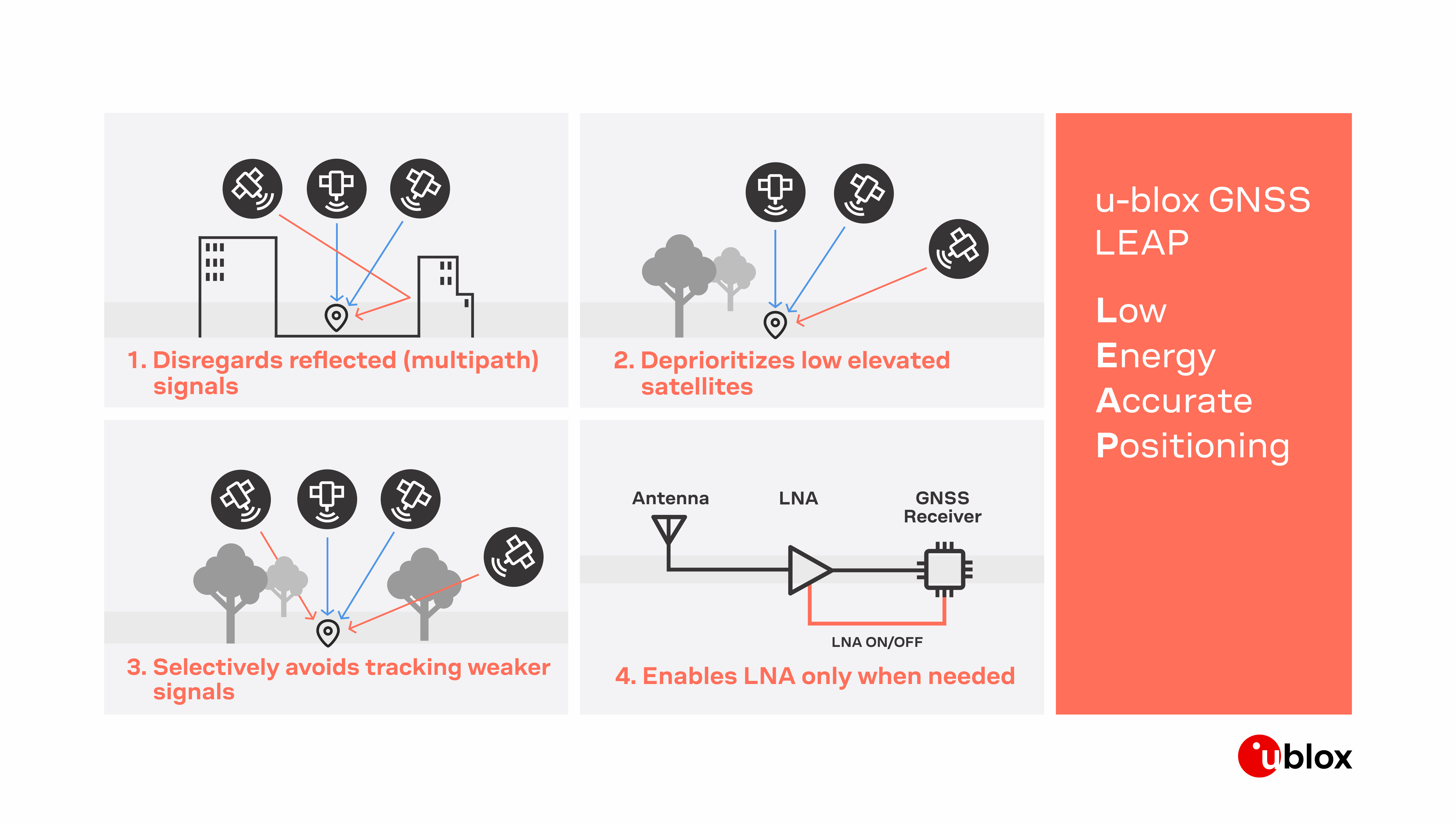
LEAP technology introduces an intelligent signal selection process, ensuring that only the most beneficial satellites are tracked, which yields better accuracy. Several criteria are employed to filter satellites effectively.
1) For instance, signals that reach the GNSS antenna through a direct line of sight are preferred, while those affected by reflections (multipath interference) are disregarded.
2) Furthermore, satellites positioned above a certain elevation angle are prioritized.
The strength of signals plays a critical role in positioning accuracy. Strong signals with a high signal-to-noise ratio yield more accurate positioning measurements, whereas weaker signals can introduce errors.
3) LEAP technology discards or selectively avoids tracking weaker signals, focusing solely on those that contribute to precise location data. This process further refines the quality of information while saving energy.
Expanding the focus beyond the GNSS chip to the entire GNSS solution reveals further potential for power savings, particularly with external components like the low noise amplifier (LNA).
4) LEAP enables the LNA as needed, saving energy without compromising functionality.
Assisted GNSS data download
Further power savings can be achieved by using aiding data, including almanac, ephemeris and correction information. Instead of spending significant energy during start up to download and decode orbital data directly from the satellites, LEAP technology leverages data obtained from the internet and injects this information into the GNSS receiver.
5 mW low update rate tracking
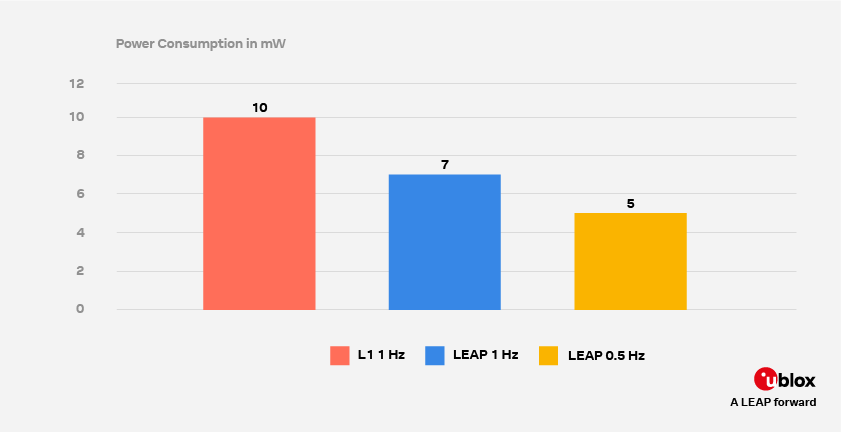
GNSS receivers by default output a position once per second (1 Hz) in continuous tracking mode. For many applications, receiving a position every second might be more than necessary. Reducing the update rate to one position every two seconds (0.5 Hz) can still meet the requirements of many use cases while lowering power consumption by an additional 30%, down to 5 mW. As a result, battery life can be extended (up to 2x or 100%) when using LEAP mode with a lower update rate.
Efficiency Meets Accuracy: 50% Power Reduction, Accurate Positioning
Combing all improvements 1) – 4) helped to cut energy consumption by 50% while maintaining excellent position accuracy in different conditions ranging from open-sky, forest and urban canyons.